
Featured
Bamidele’s Masterstroke That Made Oyebanji’s Second Term Push Easier

By Emmanuel Adeniran
In Ekiti politics, second terms are not given. They are negotiated, fought for, and often lost. Since the return of democracy in 1999, no governor had ever won re-election back-to-back.

That jinx was broken on June 20, 2026, when Governor Biodun Oyebanji polled 319,224 votes to defeat his closest challenger, Dr. Wole Oluyede of the PDP, who scored 40,543 votes.
It was a landslide on paper. In reality, landslides are not made on election day. They are built months earlier, in caucus rooms and meeting halls, by making enemies sit at the same table. That was where Senate Leader, Senator Opeyemi Bamidele, did his most decisive work.
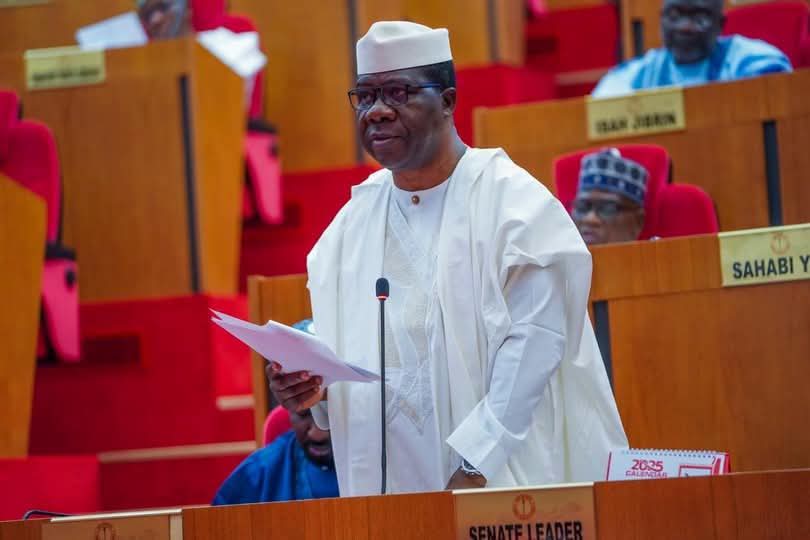
As Chairman of the All Progressives Congress, APC, Governorship Election Campaign Council in Ekiti, Bamidele was not just a campaign manager. He was the architect of inevitability.
1. He Locked Down Ekiti Central Early:
Every Ekiti politician knows the arithmetic: whoever wins Ekiti Central wins Ekiti. With Ado-Ekiti and five local governments, it is the state’s largest voting bloc.
Bamidele moved first. Long before INEC released its timetable, he led frontline APC leaders in the district to Fajuyi Pavilion, Ado-Ekiti, for a special senatorial meeting where they endorsed Oyebanji as the sole candidate for the 2026 poll.
The motion, ratified by a thunderous voice vote, was moved by Senator Babafemi Ojudu and seconded by Hon. Biodun Omoleye and Hon. Sola Fatoba, with the backing of former Acting Governor Tope Ademiluyi and others.
Professor Modupe Adelabu, who chairs the Central stakeholders, clarified that the endorsement did not abridge anyone’s right to contest, but stressed that Oyebanji would enjoy the “full and solid backing of all APC members in the district.”
In a state where primaries are often bloodier than the general election, that single act took the oxygen out of any internal rebellion.
2. He Turned Unity Into a Campaign Strategy:
If Oyebanji’s selling point was humility and performance, Bamidele’s selling point for him was unity.
After the victory, Bamidele noted that Oyebanji had transformed Ekiti’s political atmosphere from one previously marked by division and rivalry into one focused on cooperation and collective progress. He described the governor’s ability to build strong relationships across party lines as a rare achievement.
But that unity did not build itself. Bamidele was its broker.
At the Ekiti Parapo Pavilion endorsement of President Bola Ahmed Tinubu and Governor Oyebanji, former governors who once refused to share a stage — Niyi Adebayo, Kayode Fayemi, Segun Oni and even Ayodele Fayose — stood together. Bamidele, flanked by serving and former National Assembly members, moved the motion for Tinubu’s endorsement, seconded by Hon. Femi Bamisile.
Months earlier in Abuja, Fayose had declared: “I will never join your party but we will support you to complete the journey you have started.”
That cross-party cover made it impossible for the opposition to mount a credible narrative against the incumbent.
3. He Gave It an Ideological Frame: The Lagos Continuity Argument:
Bamidele gave the second-term push a frame Ekiti people understood — continuity.
During his thank-you visit to the APC State Executive, he said: “Anyone familiar with what has happened in Lagos State between 1999 and now will understand the beauty and progress that come with continuity. Ekiti deserves that same beauty and progress.”
That framing was powerful. It turned Oyebanji’s re-election from a personal ambition into a developmental necessity. It was no longer APC versus PDP, but about making Ekiti a model of stable leadership.
4. He Managed the Primary to Avoid Bloodshed:
The most dangerous moment for any incumbent is the primary. Bamidele managed it.
With two aspirants disqualified and one withdrawing, the APC was able to present Oyebanji as a consensus candidate. Bamidele himself returned to Ado-Ekiti to participate as a delegate, calling for “a governorship primary devoid of rancour where no man will be molested, where no one will lose his life… and where there will be no spilling of blood.”
By preaching and enforcing reconciliation, he denied the opposition the usual gift of a fractured ruling party.
5. He Wrote History Before It Happened:
When the Returning Officer, Prof. Adenike Oladiji of the Federal University of Technology, Akure, announced the results at the collation centre in Ado-Ekiti, the outcome felt pre-written.
Oyebanji made history as the first governor to be re-elected back-to-back since 1999.
Bamidele, in his congratulatory statement, described the victory as “a signpost for a better, brighter and greater Ekiti” that will sustain development and unity.
Governors campaign with projects. Godfathers campaign with structure. But Bamidele campaigned with something rarer in Ekiti: peace.
By stitching Central together, neutralizing the party’s warring generals, and selling continuity over contention, he ensured that by the time Oyebanji went to the polls, he was not running against an opponent. He was running with the entire Ekiti political establishment behind him.