
Education
JABU at 20: From Hopelessness to Usefulness – VC Gives Account of Two Decades

By Joseph Sunday
From hopelessness to usefulness, that is how the Vice-Chancellor of Joseph Ayo Babalola University, Ikeji-Arakeji, Prof. Olasebikan Alade Fakolujo, summarized twenty years of the institution’s journey as he gave account of two decades of its existence.
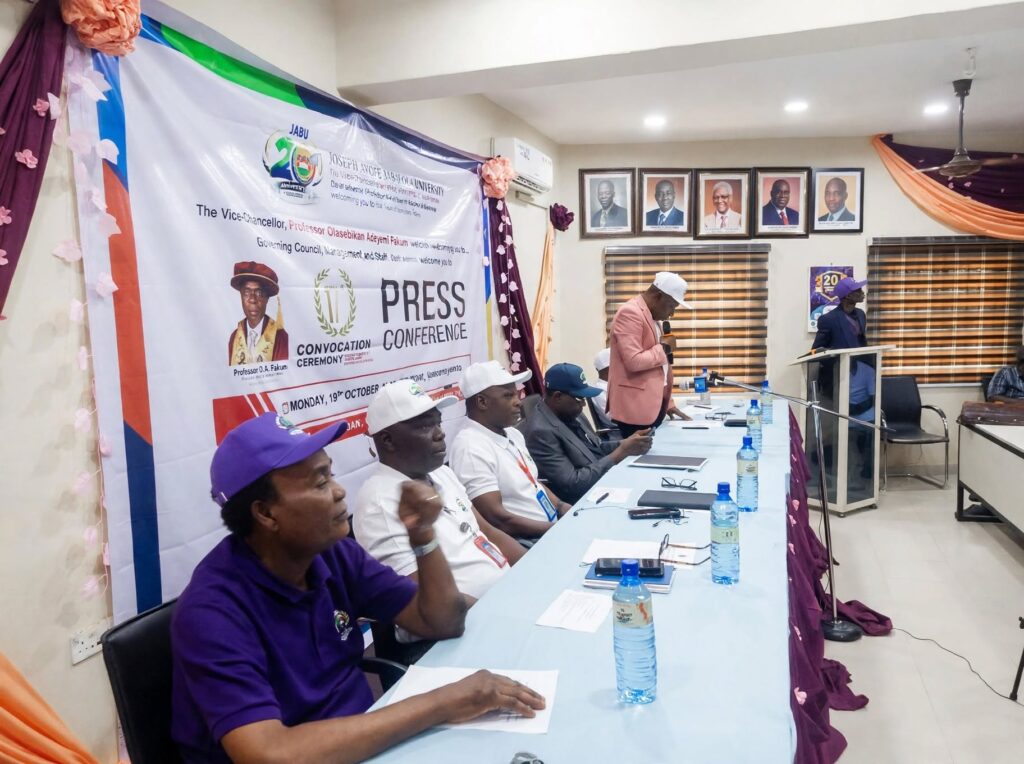
Prof. Fakolujo spoke on Monday, 19th October 2026, at a press conference held at the Senate Chamber as part of activities marking the institution’s 20th anniversary and 17th convocation ceremony.
The press conference was themed: “Crossing From Hopelessness to Fruitfulness and Usefulness: Twenty Years of Faith, Impact and Service,” while the main anniversary theme is “Two Decades of Divine Grace, Growth and Glory.”
According to Prof. Fakolujo, the celebration is not just about longevity, but about accountability.
“What have twenty years actually produced? What has changed? Whose life is better because this university exists? Having been entrusted with twenty years, what have we done with them?” he asked.
The Vice-Chancellor traced JABU’s spiritual root to 9th October 1928, when a young Joseph Ayo Babalola was working with a steamroller near River Ariran, close to the university’s second gate, and the machine stopped without any mechanical explanation. That stoppage, he said, became the turning point that led to one of Nigeria’s most consequential indigenous Christian revival movements and the emergence of the Christ Apostolic Church.


“Sometimes what appears to be a stopping point becomes another starting point. Sometimes a difficult road does not end a journey, it changes its direction,” he said.
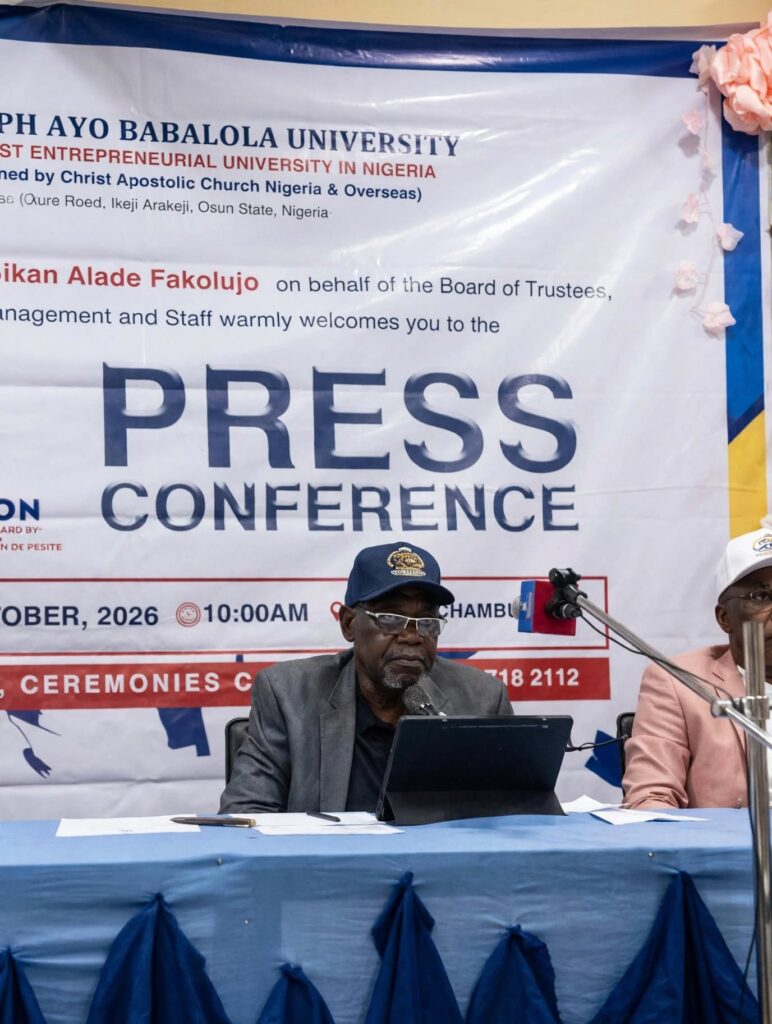
He clarified that the phrase “Crossing from Hopelessness to Fruitfulness and Usefulness” does not describe the founders or host communities as hopeless, but rather how scarcity, unemployment and limited opportunity can make people feel that nothing worthwhile can emerge – a feeling many Nigerians understand.
He said the anniversary is anchored on three purposes: to give account, to give thanks, and to recommit.
“Twenty years ago, parents entrusted their children to an institution without alumni or reputation, the Christ Apostolic Church invested faith and resources, and staff came to build careers in a university that was still being built. We are not simply saying ‘look how old we are.’ We are saying this is what we have done with what was entrusted to us,” he said.
While JABU became operational in 2006, the vision started earlier. On Thursday, 31st January 2002, the Planning and Implementation Committee for the proposed university was inaugurated by the then President of the Christ Apostolic Church, Pastor Elijah Howard Lajuwon Olusheye.
The university was approved by the Federal Executive Council on 8th February 2006, received its operating licence on 6th March 2006, and opened for the 2006/2007 academic session on 25th October 2006.
Its first matriculation was held on 2nd February 2007 with 246 pioneer students.
“Those 246 were our ‘day of small things’ – Zechariah 4:10. They believed before much of the evidence existed,” Fakolujo noted.
Twenty years later, the university has awarded over 10,000 undergraduate degrees and hundreds of postgraduate degrees.
The founding Academic Brief did not envision JABU as just another degree-awarding institution, but as a university that would produce graduates capable of self-employment and self-reliance, direct research to Nigeria’s social and economic problems, and make entrepreneurship compulsory.
That philosophy is captured in its motto: For Knowledge and Godly Service.
Three Achievements in Twenty Years:
Prof. Fakolujo summarized the two decades into three broad achievements:
1. Institution Building: Building programmes, systems, traditions and identity.
2. People Development: Through partnerships such as Google for Education – leveraging Gmail, Drive, Docs, Meet and Classroom to enhance teaching, collaboration and research.
3. Entrepreneurial Education: By 2011, the JABU Skills Acquisition and Innovation Centre was operational.
By 2012, it had over 17 skills areas and was accredited alongside the entrepreneurship degree programme.
The model attracted national attention. The University of Ilorin and the Federal University of Technology, Akure, sent delegations to understudy it.
During his ministerial screening on 22nd October 2015, Prof. Claudius Omoleye Daramola referenced JABU while advocating entrepreneurship education for Nigeria. Three years later, his ministry used JABU to train Niger Delta youths under a Federal Government programme.
Today, JABU has moved from entrepreneurship training to entrepreneurship education, to postgraduate scholarship and doctoral research. At the 17th convocation, the university will graduate PhD holders in Entrepreneurship among 22 PhD graduands.
Pioneering Distance Learning:
In 2016, JABU became Nigeria’s first private university approved by the National Universities Commission to operate a Centre for Distance Learning, expanding access for working professionals through its LMS and virtual classrooms.
Contribution to Church and Society:
Through the Enhanced Leadership and Administrative Training, ELAT programme, JABU has trained over 9,170 CAC pastors and their wives, alongside ministers from 36 states, the FCT, Benin Republic, Togo, USA and the UK.
Its Human Resource Development Board has also impacted about 15,000 managers, business owners and civil servants across Nigeria, with participants from Germany and Israel.
Other impacts include its Medical Centre serving host communities, a 60-acre teaching and research farm in collaboration with IITA, and the annual distribution of thousands of oil-palm and cocoa seedlings to farmers.
From four Colleges at inception – Agriculture and Natural Sciences, Humanities, Social and Management Sciences – JABU now runs Colleges of Environmental Sciences, Law, Health Sciences and Postgraduate Studies.
In 2025, five programmes presented to the NUC – Medical Laboratory Science, Nursing Science, History and International Studies, Estate Management and International Relations – all received full accreditation. Four professional programmes also received full accreditation. In August 2026, the Council of Legal Education increased JABU’s Law quota from 50 to 100.
The 17th Convocation:
For the 17th convocation, JABU will present 1,043 graduands – 897 first-degree and 146 postgraduate.
The first-degree breakdown: 87 First Class, 429 Second Class Upper, 301 Second Class Lower, 74 Third Class and 10 Pass.
Postgraduate: 22 PhD, 94 Masters, 27 MBA and 3 Postgraduate Diplomas.
The best graduating student, from Food Science and Technology with a CGPA of 4.96, will receive N1 million from the Chancellor, while 83 other First Class graduands will receive N500,000 each. The overall best female graduand will also receive N5 million endowed by the First Lady of the Federal Republic, Senator Oluremi Tinubu.
Medical Laboratory Science students recorded 100% success in their professional examinations for three consecutive years. Nursing Science recorded 100% success in the 2026 Registered Midwife professional examination.
At the Nigerian Law School, five JABU Law graduates earned First Class in 2024, including Omowumi Comfort Omoniyi who also won the Director-General’s Prize. In 2025, three earned First Class, and in 2026, Adams Omowonuola Avinpe, Teibe Precious Abisola and Thirinde Oluwayemi Abidemi also earned First Class.
Among its notable alumni is Dorathy Bachor, Accounting graduate turned entrepreneur and public figure, alongside thousands of teachers, health workers, entrepreneurs and civil servants.
Former JABU Vice-Chancellor, Prof. Isaac Oluwatobi Fajana, became Vice-Chancellor of the National University of Lesotho. Former Acting VC, Prof. Kehinde L.T. Eniola, became pioneer VC of Kogi State University, Kabba. Former Pro-Chancellor, Prof. Joash Ojo Amupitan, SAN, who served from November 2011 to September 2025, was sworn in as Chairman of INEC on 23rd October 2025.
The Chancellor, Pastor Anthony Obiagboso, connected the university to the national grid and instituted an excellence prize scheme that has grown from N17.5 million in 2024 to N24 million in 2025 and N27 million in 2026.
The Next Twenty Years: 2027-2031 Strategic Plan:
Prof. Fakolujo unveiled JABU’s first formal Five-Year Strategic Plan built on four pillars: Academic Excellence, Research and Innovation; Digital Transformation and Infrastructure; People and Governance; and Sustainability, Partnerships and Societal Relevance.
“We must measure what we claim. Are our graduates finding employment? Are our partnerships active, not just signed?” he said.
The convocation lecture titled “Public Service Governance and Institutional Reforms: A Constant Imperative for Our National Development” will be delivered by Dr. Goke Adegoroye on Thursday, October 22, 2026.
Two eminent Nigerians will receive honorary doctorates: Prof. Felix Babatunde Oluyemisi Dayo and Dr. Goke Adegoroye.
He concluded: “Twenty years have given us history. They do not give us permission to become history. The road continues.”