
Education
17th JABU Convocation Lecture: Merit Must Be Non-Negotiable — Ex-BPSR DG Tells FG

... Says Nigeria Needs Ethical Reformers, Not Just Graduates
By Joseph Sunday
Merit must be non-negotiable in public appointments if Nigeria is to escape decades of institutional failure, former Director-General of the Bureau of Public Service Reforms, BPSR, Professor Goke Adegoroye, has told the Federal Government.
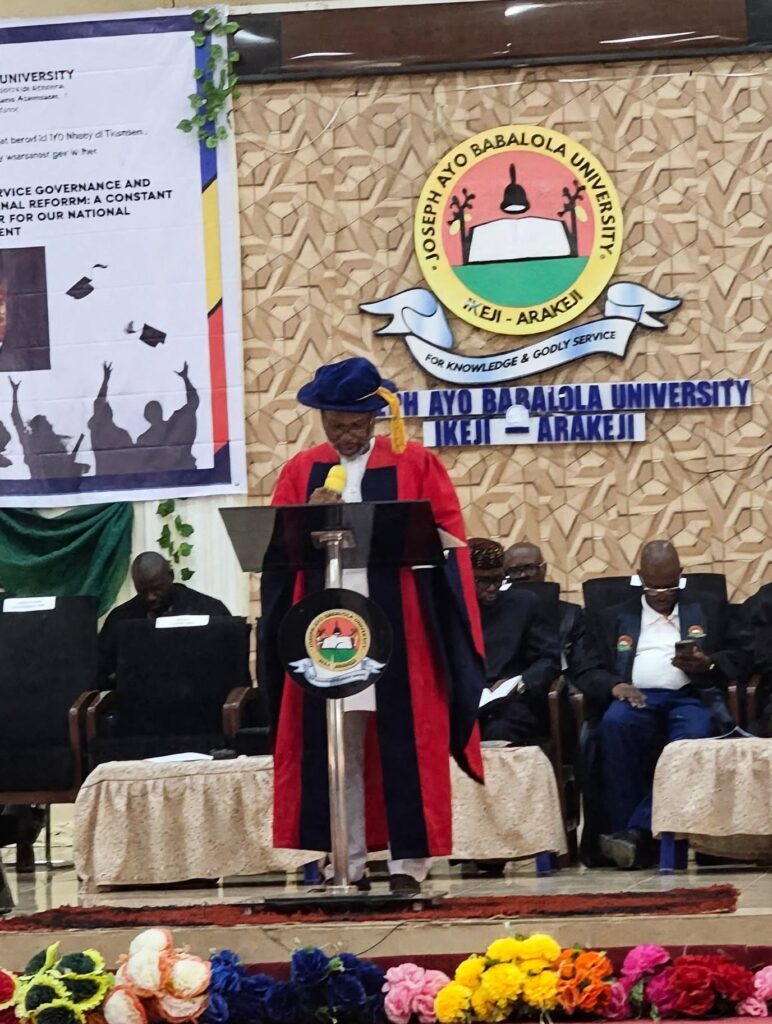
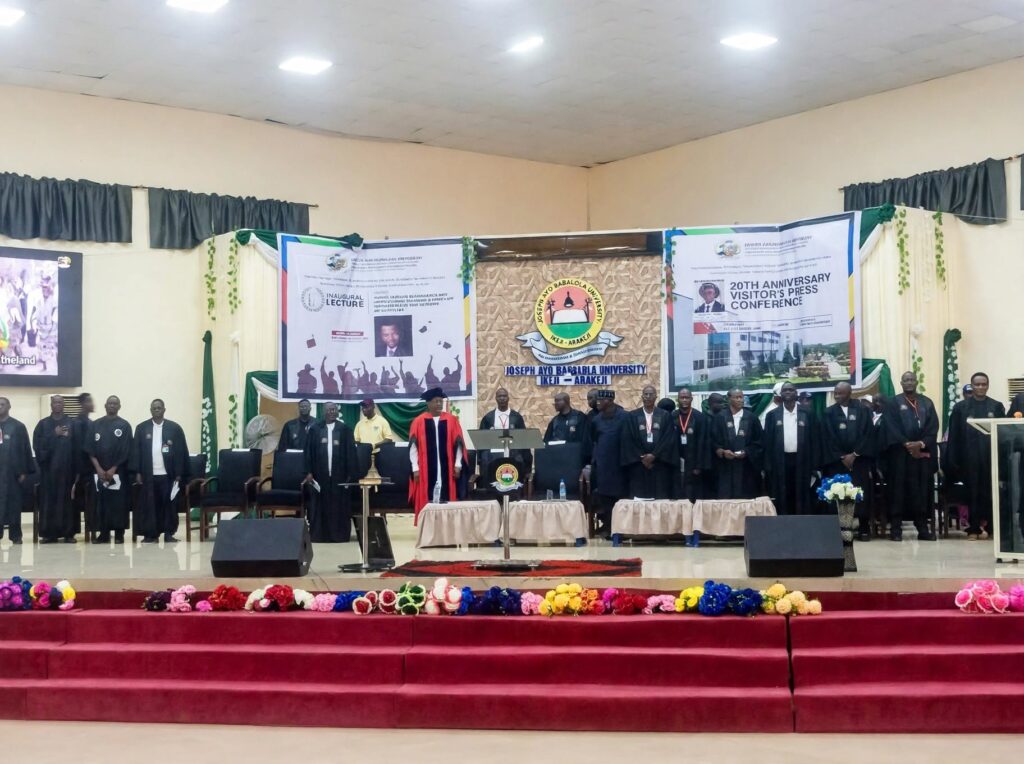
Delivering the 17th Convocation Lecture of Joseph Ayo Babalola University, JABU, on Thursday, 22nd October, 2026, as part of activities marking the institution’s 20th anniversary, Adegoroye said Nigeria needs ethical reformers, not just graduates, to fix a public service whose failure he traced to colonial legacy and deep structural flaws.
The lecture, themed “Public Service Governance and Institutional Reforms: A Constant Imperative for Our National Development,” was held at the university campus in Ikeji-Arakeji, Osun State.
Adegoroye, an environmental scientist turned reform champion, warned that Nigeria’s paradox remains painful 66 years after independence. While the country is richly endowed, he said, nations like Singapore, South Korea, Malaysia, Indonesia, China, Botswana and Mauritius which were at par with Nigeria at independence have left it far behind — a gap he attributed not to geography but to governance, institutions and values.
Colonial hangover, structural defects:
Tracing the root of the crisis, the former BPSR boss said the Nigerian public service was never designed for development.


“The Nigerian public service is a British legacy. It grew out of treaties with individual kingdoms and the Amalgamation of 1914. Its mandate was never designed for national development, but for the maintenance of colonial law and order and extraction of resources,” he said.
He recalled that early reforms — from the Harragin Commission of 1945 to Adebo in 1971 — focused largely on wages and Nigerianisation, while the Udoji Commission of 1972-1974 recommended a unified professional service.
He described the 1988 Civil Service Reforms under Decree No. 43 as the most maligned, noting that by making the Minister Chief Executive and decentralizing appointments to MDAs, it clogged career progression.
On return to democracy in 1999, he said, President Olusegun Obasanjo inherited what the Danjuma-led Presidential Policy Advisory Committee called “an over-bloated, lopsided, ill-equipped, poorly paid, rudderless institution lacking in initiative” — with bureaucracy expanding 350% between 1960 and 1999 while population grew by 150%.
Adegoroye listed the Monetisation Policy of 2003 as the most successful reform in cost-saving and curbing corruption, alongside other initiatives like IPPIS and Treasury Single Account, TSA.
Yet, he argued, reforms have not delivered. Citing World Bank Governance Indicators, he said Nigeria’s Government Effectiveness score hovered around minus one — from -0.92 in 2016 to -1.01 in 2024, placing Nigeria 40th of 53 African countries. The Mo Ibrahim Index 2024 scored Nigeria 45.7/100, below Africa’s average of 49.3.
He identified four causes: administrative bottlenecks, corruption and patronage, political interference, and cultural and technological lag.
He pointed to a fundamental structural flaw: “There is no single office that coordinates the entire federal public service. The Head of Civil Service has no authority over police, military, intelligence, anti-corruption and revenue services. Its reach is less than 10% of federal workforce. The Secretary to the Government of the Federation cannot arbitrate excesses of governing boards in parastatals.”
Reform a constant imperative
Adegoroye said reform is not a destination but a permanent journey, driven by economic pressure to move beyond oil, a broken social contract where citizens pay bribes for passports or wait months for pensions, a youthful demography with median age 18 confronting an analogue administration, and global shocks from pandemics to Artificial Intelligence.
While Nigeria has not lacked tools — IPPIS, TSA, e-passport — he said “The network is down has become subterfuge,” stressing that the missing link is integrity.
“The roadmap to resilient public service rests on four pillars: digital transformation, meritocracy, structural rationalisation, and independent oversight. Integrity in leadership enables office holders to act independently, upholding national interest over partisan, ethnic or personal interests,” he said.
Seven-point charge to FG, role for universities:
He charged political leadership to: Remove structural and constitutional impediments in the offices of SGF and Head of Service for effective coordination.
Let civil service experience prevail in selection of SGF, consistent with sections 169 and 171 of the Constitution .
Give the Office of the Chief of Staff to the President proper constitutional recognition
Make merit non-negotiable in appointments
Overhaul HR management and institute leadership development on integrity
Establish a Federal Public Service Council to harmonise relationship.
Drive national value re-orientation that places ethics and national interest above sectional interests
He also tasked universities to realign curriculum to integrate data analytics, e-governance and AI, become evidence-based think tanks, and form character to produce ethical public managers.
“Go as agents of renewal”
In a direct charge to the JABU Class of 2026, the former DG, who holds a PhD in ecophysiology but led public service reforms, urged graduates not to be limited by their field of study.
“Public service is a sacred trust. Go forth as agents of renewal. Where others see bureaucratic bottlenecks, create efficient pathways. The future of nations is not built by brilliant but self-serving opportunists. It is built by men and women of competence, character, courage and conviction,” he said, invoking the legacy of Apostle Joseph Ayo Babalola for an “administrative revival” against corruption, inertia and nepotism.
Earlier in his welcome address, Vice-Chancellor, Professor Olasebikan Alade Fakolujo, said the convocation lecture was fitting as JABU marks 20 years of God’s faithfulness, having commenced anniversary activities on October 12 with exhibitions, press conferences and revival services.
“A university does not exist merely to award degrees. It exists to develop minds, shape character, advance knowledge and prepare men and women capable of responding meaningfully to the challenges of society,” Fakolujo said.
He described Adegoroye’s career as testimony of what scientific knowledge and intellectual rigour can achieve, citing his books Restoring Good Governance in Nigeria (2015) and Leadership in the Nigerian Civil Service: Five Decades of Lessons in Performance, Encounters and Triumphs (2025).
“Our nation needs more than graduates who can succeed within existing institutions; it needs graduates with the competence and character to make those institutions better,” the VC added.
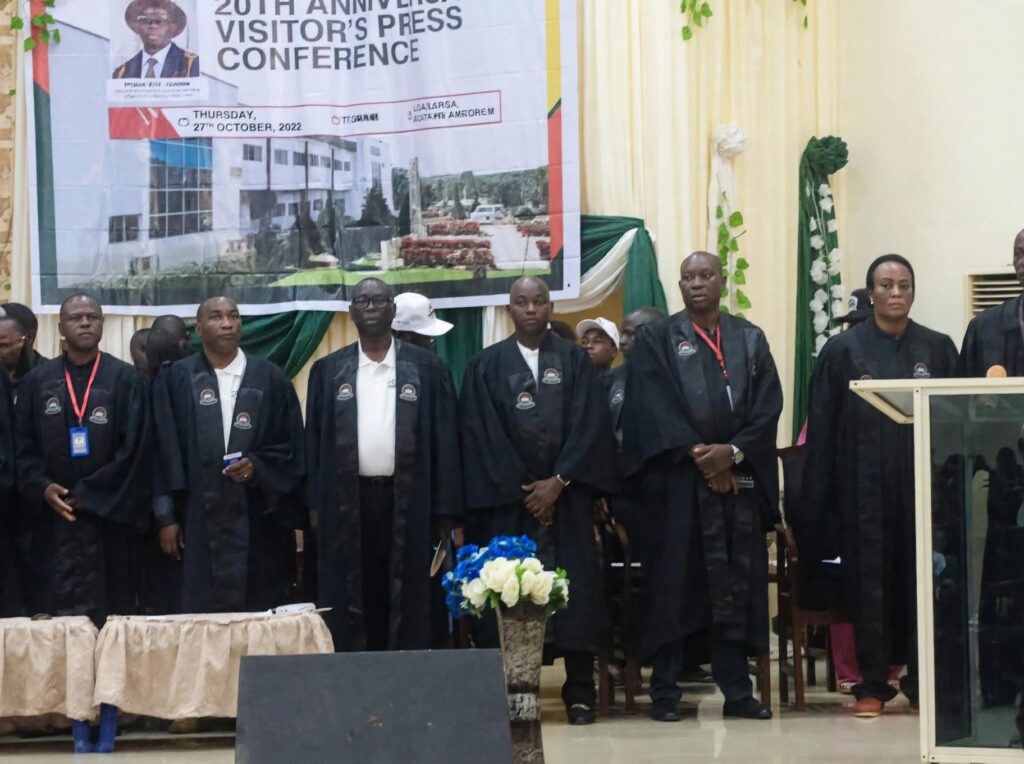
Dignitaries present included the President of Christ Apostolic Church, Nigeria and Overseas and Chairman, Board of Trustees, the Chancellor, Emeritus Professor Anthony Olusegun Adegbulugbe, Pro-Chancellor Professor Shola Fajana, royal fathers, spiritual leaders, Vice-Chancellors, including Prof. K.I.T. Eniola of Kogi State University, Kabba, and members of the university community.