
Education
INEC Pledges Neutrality as KDI Warns, Says Violence Threatens 2027 Polls

By News Desk
With 51 days to the 2027 General Elections, the Independent National Electoral Commission (INEC) has pledged absolute neutrality and readiness for a credible poll, even as the Kimpact Development Initiative (KDI) warned that escalating political violence threatens participation and public confidence.

The assurances and warnings came on Wednesday in Abuja at the Nigeria Election Risk and Readiness Summit 2026, organised by the Centre for Journalism Innovation and Development (CJID) under the theme: “Securing the Votes, Protecting the Frontliners.”
Delivering the keynote on behalf of INEC Chairman, Prof. Joash Amupitan, SAN, his Chief Press Secretary, Mr Oketola Eriye, said Nigerians will vote on Saturday, 16th January, 2027 for President and National Assembly members, and on Saturday, 6th February, 2027 for Governorship and State Houses of Assembly elections.
INEC also announced a nationwide mock accreditation and result transmission exercise this Saturday, 28th November, 2026, in two polling units per ward across the 36 states and the FCT.
The Commission said it is rebuilding trust after the 2023 deficit through transparency, predictability and candour, using off-cycle elections in Anambra, Ekiti and Osun, the FCT Area Council polls and 16 legislative bye-elections to test reforms.
It listed four readiness pillars under the Electoral Act 2026: a National Register of Voters of over 100 million, after over 10.77 million new registrants were added and over 1.6 million invalid, duplicate or deceased records were purged, including 232,658 Persons With Disabilities; a hardened INEC Result Viewing Portal (IReV) that automatically rejects Form EC8A results failing arithmetic checks or showing over-voting; 57,000 new BVAS devices, with the threshold lowered from 1,250 to 850 voters per machine; and immutable BVAS accreditation logs, authenticated IReV uploads and prompt Certified True Copies.
INEC said it has created an Artificial Intelligence Division to detect coordinated manipulation, warning that fake relocation audio, doctored ballot-stuffing videos and premature synthetic results could trigger panic, suppress turnout and spark violence. It called for an alliance with fact-checkers like DUBAWA, newsrooms, civil society and the National Orientation Agency.
On frontliners, it said over 1.41 million ad hoc personnel, mostly NYSC members, will be deployed, and condemned attacks on campaign convoys, party offices, supporters, INEC officials and journalists tracked by CJID’s Press Attack Tracker.


“Election officials and accredited reporters are not combatants in a partisan war; they are constitutional public servants and civic watchdogs discharging a sacred national duty,” it said.
INEC stressed it is not a security agency and cannot maintain order, effect arrests or deploy armed security, a duty it said rests with the Nigeria Police Force and partner agencies.
It cited Sections 95, 96 and 97 of the Electoral Act 2026 on rallies, campaign conduct and offences, noting Section 96 prohibits inflammatory language and armed political vanguards, while Section 97 prohibits threats or coercion, with penalties of up to ₦5 million or 12 months imprisonment for individuals and up to ₦10 million for parties. Under Section 148, it can prosecute offenders directly on receipt of Police case files.
It also disclosed the restructuring of the Inter-Agency Consultative Committee on Election Security (ICCES) into decentralised ICCES Tentacles down to every LGA and Ward, guided by its Election Risk Management Tool.
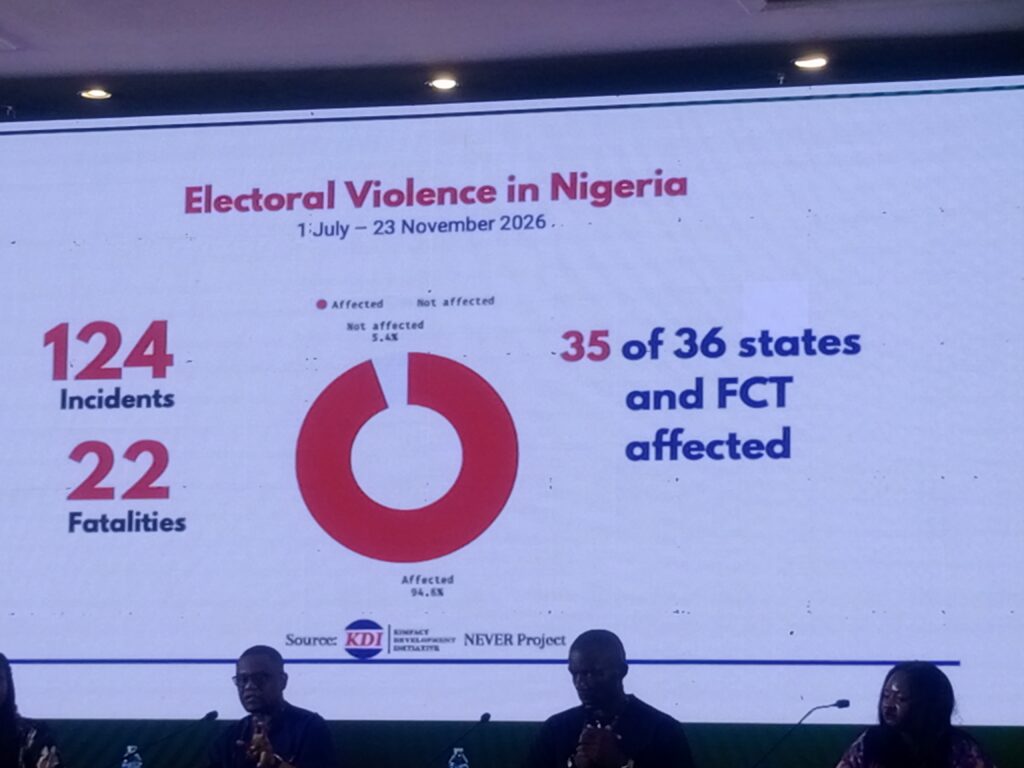
KDI, through its Nigeria Election Violence Education and Reporting (NEVER) Project, presented a contrasting picture: 124 incidents of electoral violence between 1st July and 23rd November, 2026, resulting in 22 fatalities across 35 states and the FCT.
Cases rose from 3 in July to 48 in October and 40 in the first half of November alone, linked to the start of presidential campaigns. The breakdown was 46.8 per cent physical assault, 28.8 per cent property destruction, 10.2 per cent shootings, 9 per cent intimidation and harassment, and 4 per cent kidnappings. Kano, Delta, Rivers, Edo, Ondo and Kebbi recorded significant levels.
KDI said party members and affiliated groups were perpetrators in 82.3 per cent of incidents and victims in 86.5 per cent, and raised concern over intolerance, restrictions on opposition activities and abuse of administrative authority.
It warned of an accountability gap, saying several arrests since January 2026 have been publicly reported without publicly available evidence of corresponding prosecutions or convictions.
“This accountability deficit weakens deterrence and can create the perception that perpetrators of electoral violence can act with impunity,” KDI said.
Speaking at the summit, KDI’s Bukola Idowu said violence persists not because Nigerians are unwilling to stop it, but because institutions conducting elections lack independence.
“Election is a multistakeholder affair,” she said. “ INEC is just one. And the rest have the capacity to make INEC more miserable.”
She said there is an orchestrated effort to delegitimise INEC, faulted misinformation such as claims that citizens can vote without their Permanent Voter Card, and said INEC must stop being reactive because misinformation travels faster than fact-checks.
She said about 60 per cent of private media outlets have political affiliation, turning elections into a competition to control narratives, and faulted the judiciary, saying a single judgment can spark violence because politicians believe what parliament cannot give, the court can give.
She said three major parties perpetrate most violence, not because smaller parties are more peaceful, but because violence requires huge resources, and questioned why persons who openly incite killing, including sitting lawmakers, are not swiftly prosecuted. She said Nigeria has had uninterrupted elections, not uninterrupted democracy, citing Freedom House’s categorisation of Nigeria as an authoritarian democracy.
Findings showed 38.2 per cent distrust INEC, 36.17 per cent have confidence in it, and 25.6 per cent are unsure. For the judiciary, 36.6 per cent distrust, 34.1 per cent trust, and 29.2 per cent are unsure. For security agencies, 39.0 per cent trust, 34.7 per cent distrust, and 26.3 per cent are unsure.
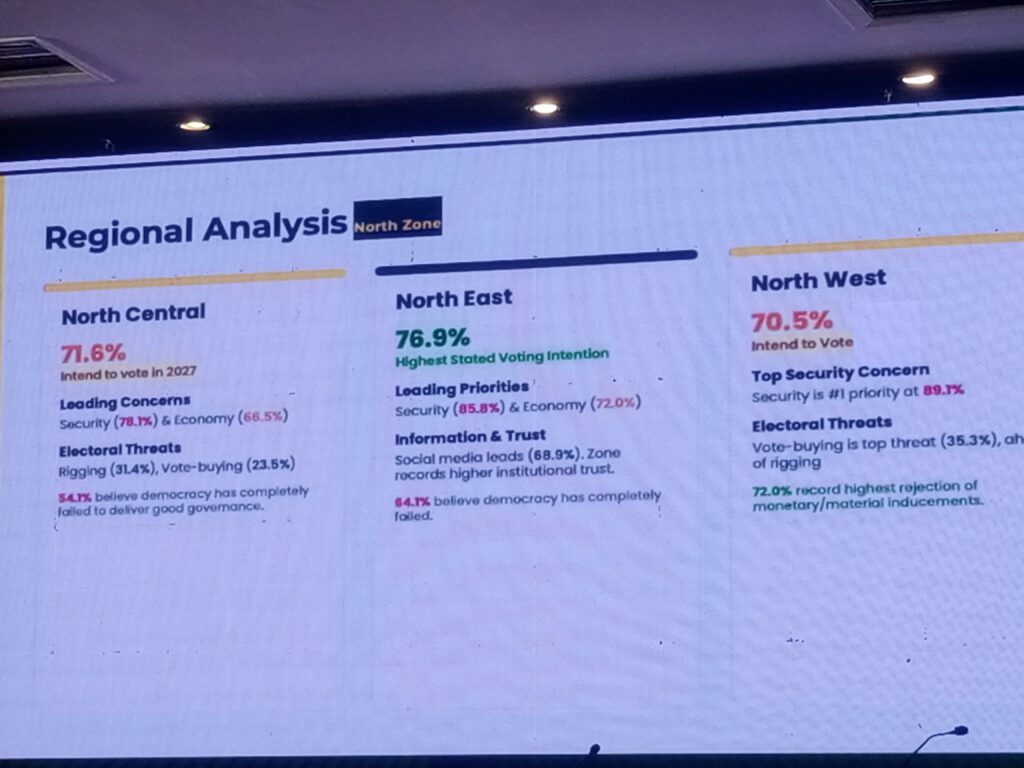
On vote inducement, 26.46 per cent said they would accept money or gifts for their votes. Voting intention stood at 71.6 per cent in North Central, 76.9 per cent in North East, and 70.5 per cent in North West. Security and economy topped concerns, while rigging and vote-buying were named as leading threats.
INEC closed with a pledge of neutrality:
“Our loyalty belongs exclusively to the Constitution of the Federal Republic of Nigeria, the Electoral Act 2026, and the sovereign will of the Nigerian voter. We have no preferred party, no favoured candidate, and no hidden agenda beyond ensuring that every eligible citizen can vote safely and that every valid vote counts.”