Featured
Power Without Exit? Rethinking Nigeria’s Recycling of Political Leadership

By Kemisola Folarin
Nigeria’s democratic journey continues to evolve, yet certain patterns within its political landscape are becoming increasingly difficult to ignore. One such pattern is the growing tendency of outgoing governors to transition into the Senate after completing their tenure. As the 2027 elections approach, political signals across several states suggest that a number of governors are positioning for possible moves to the National Assembly, even where formal declarations have not been made.
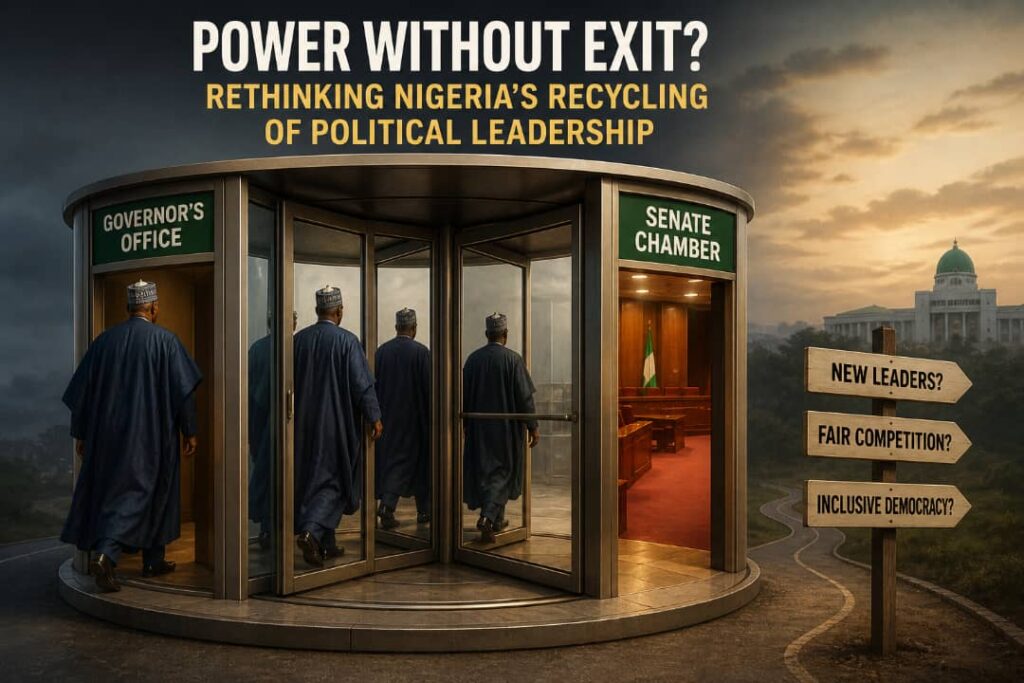
This development raises an important question: what does continuity of power mean for the future of Nigeria’s democracy?
At face value, there is nothing unconstitutional about this trend. Nigeria’s laws allow any qualified citizen including former governors to contest for legislative positions. Supporters argue that such transitions bring experience and administrative knowledge into the National Assembly, strengthening governance and policymaking.
However, beneath this argument lies a deeper concern. The increasing movement of political actors from one powerful office to another has led to perceptions of a closed political cycle, where the same individuals or networks continue to dominate leadership spaces. In the current National Assembly, a notable number of senators are former governors, reinforcing a long-standing pattern of political continuity.
For many citizens, especially young Nigerians, this raises pressing concerns about access and inclusion. If the political space is consistently occupied by established figures with strong party structures, financial influence, and name recognition, what room is left for emerging leaders?
The issue is not merely about ambition ,it is about fair competition. Outgoing governors often retain influence over political structures in their states, which can shape party primaries and electoral outcomes. This reality may tilt the playing field, making it more difficult for new entrants to gain visibility or secure party tickets.
Yet, it is important to approach this issue with balance. Political continuity is not inherently negative. Experience, institutional memory, and leadership exposure are valuable assets in governance. The concern arises when continuity begins to resemble recycling without renewal, where fresh ideas and broader representation are limited.
Democracy thrives not just on participation, but on competitive openness. A system that appears dominated by a recurring elite risks weakening public trust and discouraging civic engagement.
So, how did we get here, and more importantly, how do we move forward?
Strengthening internal party democracy is critical. Transparent primaries and fair processes can create opportunities for both experienced politicians and new entrants. Citizens, too, have a role to play through informed participation and accountability. Ultimately, expanding political inclusion especially for young people requires deliberate effort from institutions, parties, and the electorate.
The future of Nigeria’s democracy depends not only on who holds power, but on how accessible that power is.
As the nation approaches another election cycle, this moment presents an opportunity not just for political actors, but for citizens to reflect, question, and redefine the direction ofl governance.
Because democracy is strongest when it is not just a rotation of power, but a renewal of possibilities.