
Human Rights
Anambra 2025 Governorship Election: Voter Turnout Rises Amid Persistent Vote-Buying, Security Gaps – KDI

By Joseph Sunday
The 2025 off-cycle governorship election in Anambra State saw a remarkable jump in voter participation, but observers warn that persistent vote-buying, logistical delays, and security gaps continue to threaten electoral integrity. KIMPACT Development Initiative (KDI), through its Strengthening Electoral Accountability Project supported by the UK Foreign, Commonwealth and Development Office, monitored the election across pre-election, Election Day, and post-election phases.
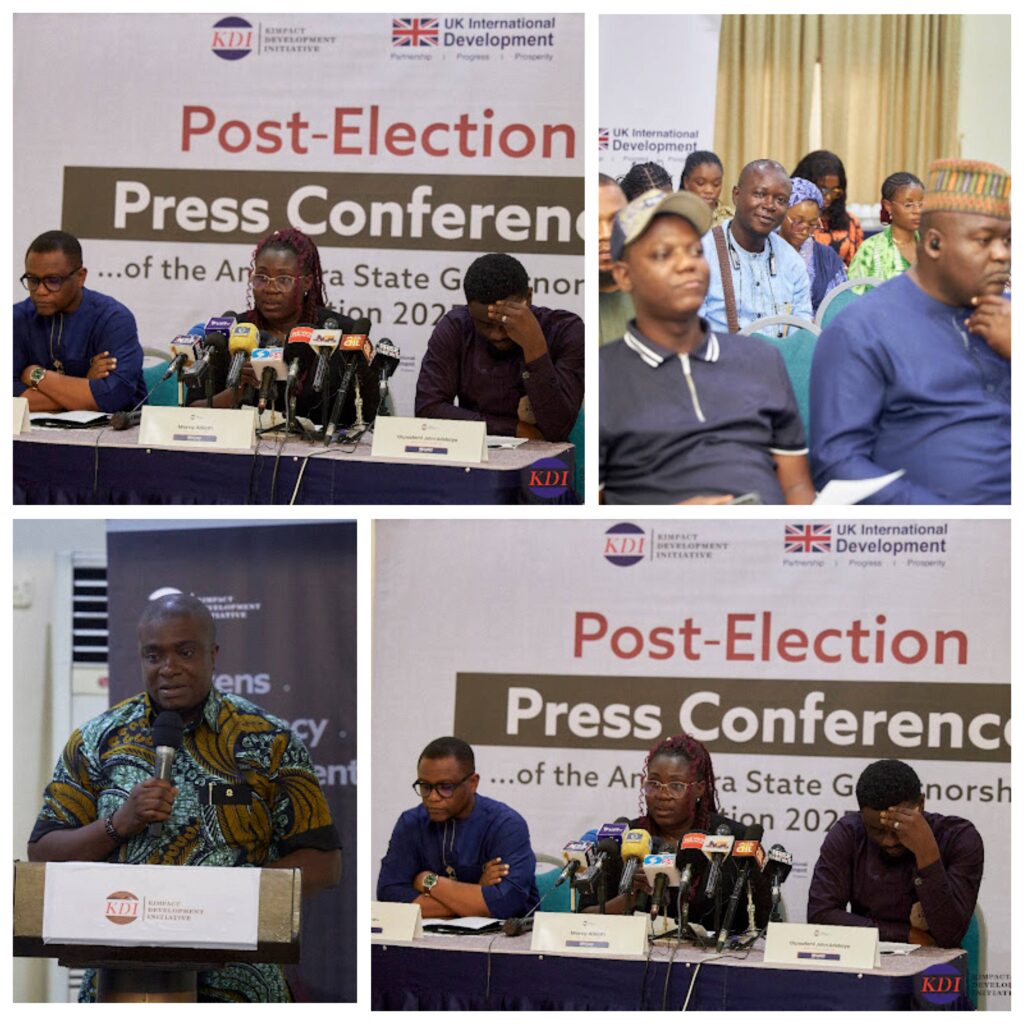
Using advanced observation tools and a dedicated Election Day Data Room, KDI tracked activities in 1,153 polling units across the state.
Preliminary findings show voter turnout rose to 21.34%, compared to just 10.26% in the 2021 off-cycle polls, a sign of renewed citizen interest and confidence in the electoral process.
The rise in participation was credited to coordinated voter mobilization efforts, civic education campaigns, and a largely calm security environment in many areas.
However, KDI noted that voting did not start on time in most polling units. Officials often arrived late or struggled to locate assigned stations, and security deployment delays contributed to accreditation and voting beginning on average forty-three minutes past the official start time of 8:30 a.m. Only 3% of polling units reported incomplete materials at the start of voting.
The Bimodal Voter Accreditation System (BVAS) functioned effectively in over 96% of polling units, with minor fingerprint verification failures quickly resolved through facial recognition.
Still, 1.59% of units experienced device malfunctions, highlighting the need for full operational readiness at all locations.
A major concern remains the secrecy of the ballot. KDI reported widespread instances of voters openly displaying marked ballots to party agents in exchange for cash or gifts, a practice observed in all 326 wards.
Such vote-trading undermines free choice and electoral credibility. Security presence was generally strong, with officers deployed in 88% of polling units. Yet, gaps were evident, and enforcement against electoral offences was inconsistent.
One fatal shooting occurred in Orumba South, while other minor incidents, including accidental tear gas discharge and post-election clashes between soldiers and police, underscored vulnerabilities in election-day security.
Party agents from several political parties, including APGA, APC, and YPP, were implicated in vote-buying, voter intimidation, and interference at polling units, highlighting the need for stricter monitoring and enforcement of electoral rules.
On results management, KDI praised INEC for timely uploading of 98% of polling-unit results to the Result Viewing Portal.
However, inconsistencies in registered-voter totals and minor discrepancies in collated results indicate gaps in data management and verification that require attention.
KDI concluded that while the Anambra election showed progress in technology use, voter participation, and early results publication, structural weaknesses in logistics, enforcement, ballot secrecy, and data integrity persist.
The organization recommended stronger pre-election planning, tighter security deployment, rigorous enforcement of electoral rules, and comprehensive civic education to safeguard the credibility of future elections.